16-12-2025: Design of accuracy, weak nonlinearity and bandwidth#
Lecture: EE4109-11
Location: Pulse-Hall 3 (33.A0.300)
Time: 15:45 - 17:30

Design considerations#
The midband (or DC) accuracy, the bandwidth and the linearity of a feedback amplifier can all be increased by increasing the loopgain:
The midband (or DC) inaccuracy with respect to the asympotic gain equals the midband (or DC) inaccuracy of the servo function. It can be decreased by increasing the midband (or DC) loop gain.
The bandwidth of a negative feedback amplifier is defined as the bandwidth of the servo function, which models the frequency dependency with respect to the asymptotic gain. The bandwidth of the servo function is determined by its loop gain-poles product, considering only dominant poles.
The differential gain error with respect to the asymptotic gain equals that of the servo function. This, in turn, can be approximated by the ratio of the differential gain error of the loop gain and the midband (or DC) loop gain.
Type of stages#
T1 matrix parameters of stages should be as small as possible (nullor-like)
Considering the midband (or DC) accuracy:
Stages that maximally contribute to the midband (or DC) loop gain: cascode stages or their balanced version.
Considering the bandwidth:
Stages that maximally contribute to the loop gain-poles product: cascode stages or their balanced version.
Considering the bandwidth:
Stages that minimally contribute to the differential error to gain ratio: cascode stages or their balanced version.
Number of stages#
Considering the midband (or DC) accuracy:
No upper limit exists. Small-signal models can be used to evaluate the midband (or DC) loop gain. The DC loop gain can be increased through addition of stages or through positive feedback with loop gain less than unity.
Considering the bandwidth:
A cascode stage can add maximally \(f_T\) to the loop gain-poles product. Hence, the bandwidth of a negative feedback amplifier can never exceed \(f_T\). The number of stages is limited by the number of dominant poles that can be handled considering stability and frequency compensation.
Considering the weak nonlinearity:
No upper limit exists. The weak nonlinearity can only be checked with numeric (SPICE) simulations. The linearity can be improved by reducing the relative signal excursions (increase bias currents and voltages), through application of compensation techniques (reduction of even nonlinearity: balancing), or by adding more stages.
Biasing and interconnection considerations#
Considering the midband (or DC) accuracy and the bandwidth
Bias current sources insert finite inpedances in parallel with the signal path
Bias voltage sources insert finite inpedances in series with the signal path
Interconnection introduces capacitances in parallel with the signal path (and cross-talk) and resistance in series with the signal path.
Considering the weak nonlinearity
Bias current sources show the desired current source behavior over a limited voltage range.
Bias voltage sources show the desired voltage source behavior over a limited current range.
Group exercise#
The whole task#
Design a controller for the hearing loop receiver that has an adequate noise performance and drive capability and that provides a sufficiently large accuray, bandwidth and linearity.
Design the feedback network from the transfer and the noise requirements.
Evaluate the controller's current and voltage drive requirements.
Check if the noise performance and the signal handling requirements can be met with a single-stage controller.
If so, check the accuracy and the bandwidth of such a single-stage solution. If both are OK:
If necessary, apply frequency compensation.
Design a simple biased circuit that can be used for verification of the linearity of this single-stage solution.
If a single-stage controller is not possible, design a two-stage solution:
Design the type, the device geometry and the operating conditions of both stages considering noise and signal handling requirements of the amplifier.
Check the bandwidth and the accuracy, if both are OK:
If necessary, apply frequency compensation.
Design a simple biased circuit that can be used for verification of the linearity of this single-stage solution.
How to proceed#
Consider a single-stage controller
Make a simple small-signal model of the amplifier from which you can estimate the asymptotic gain and the loopgain
From the loop gain and the loop gain-poles product estimate the accuracy and the achievable bandwidth
If both are OK verify your results with SLiCAP
Else, investigate if a two-stage solution gives satisfying results and verify this with SLiCAP
Is frequency compensation required?
Our solution so far#
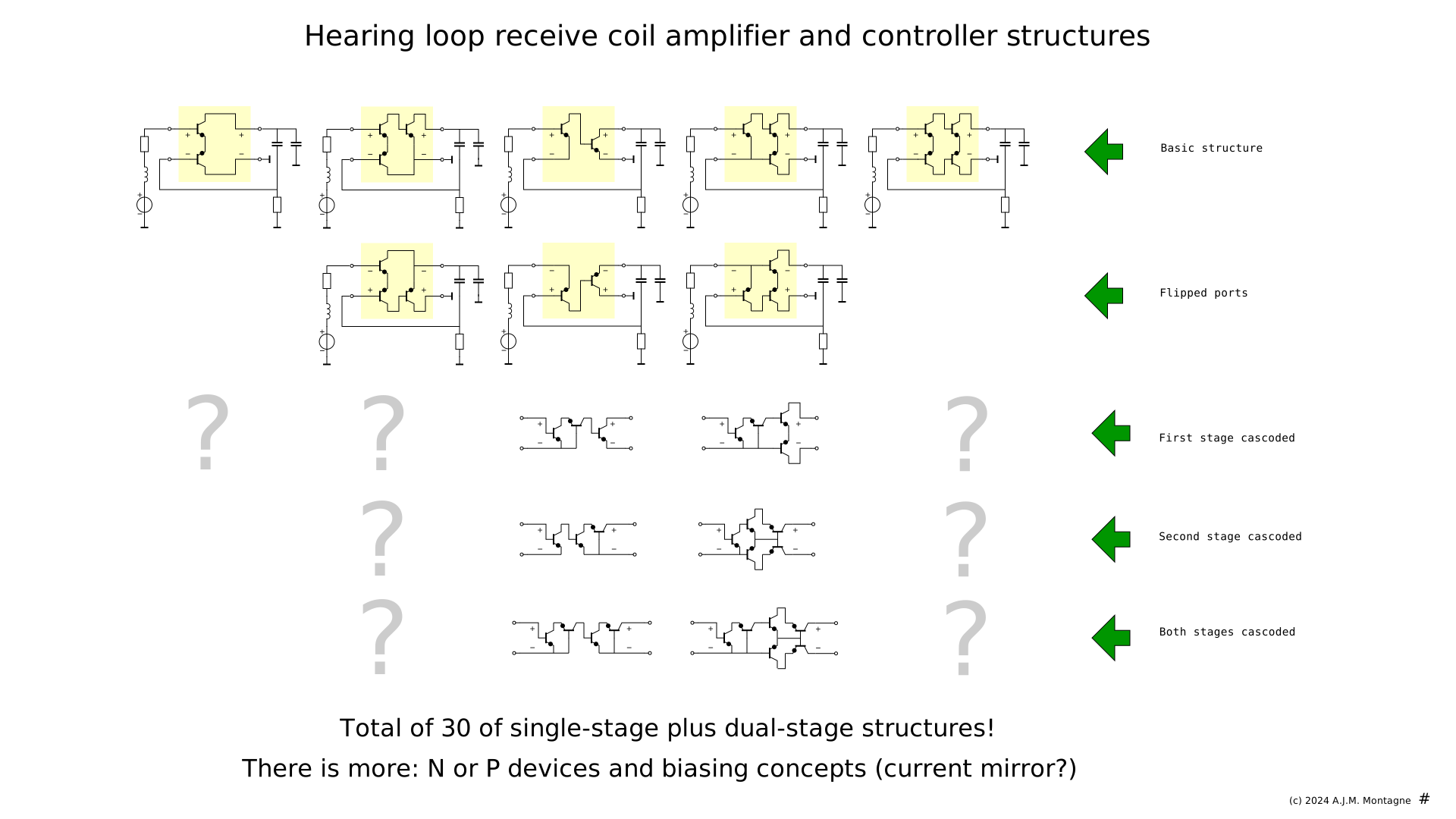
There is an updated version (4.0.9) of SLiCAP available with minor bug fixes and library additions.
>>> pip install slicap --upgrade
Please download the design project archive, unzip it, and open the notebook specifications.ipynb.
You will find the following notebooks:
specifications.ipynb Functional model of the amplifier with specifications
feedbackConfig.ipynb Design of feedback network, considering transfer, noise, and power dissipation
feedbackConfigSimple.ipynb As above, using a simplified design approach
firstStageDesign.ipynb Design and verification of CS input stage
DIN_A.ipynb Design of a NGspice DIN A weighting filter